Orient Express Part 1

Forkplay gets lost in Binondo

Lech-Get It-On!

Jon goes toe to toe with Uncle Cheffy's garlic studded pork belly lechon

This Diet Ain't Proletariat

Raise your forks to the revolution! Discover Hunan and Sichuan cooking at Komrad

Apple of My Eye

Bianca trades the Big Apple for real apple-picking in upstate New York

Pork Barrel

Roast with the most or hyped up ham? We put the Anthony Bourdain-acclaimed Zubuchon lechon to the test

Thursday, February 23, 2012

VILLA CAFÉ: Babi Rocks!

by Twinkle

When Chef Jam Melchor of Villa CafĂ© posed the question “What’s your favorite cuisine?”, I was ready with my usual repertoire of world delights: Chinese, Japanese, Italian, Korean. But before I could answer he said, “Di ba people usually say Mexican, Italian, para sosyal? Bakit hindi Filipino?” (Don't people usually say Mexican, Italian, to sound sophisticated? Why not Filipino?)

Hmmm… he did have a point.

Whether for a power lunch or liesurely dinner, expect classic Kapampangan recipes
 given a contemporary culinary makeover
Say hello to Filipino food that even your lola would approve of.  They say that Kapampangans are the ones to beat when it comes to Filipino cuisine.  Both hailing from the famous culinary capital of the Philippines, Chef Sau del Rosario and Chef Jam Melchor have dug up their treasured family recipes and used them as the foundation for their new venture – Villa CafĂ©.
“This is authentic Filipino cuisine sans the palayok,” says Chef Jam Melchor
who, together with fellow Kapampangan chef, Sau del Rosario, runs VILLA Cafe.
The first thing I saw as I walked through the doors was the pastry showcase right across the room.  Before I knew it, I was headed straight to the desserts! As I peered into the display of Filipino-inspired temptations – chocolate dulce de leche cake, dulce de tsokulate, tsokonut sansrival, etc. - I made a mental note of which items I wanted to try -- except I realized I wanted to try each one!  If they put this much thought into the desserts, I wondered, I had every right to be excited with the Villa's menu.

Our journey through the Kapampangan food wonderland began with their buro with mustasa (P195) -- a colorful array of fresh local ingredients served side by side with crispy hito (catfish) flakes, and Pampanga’s famous buro (fermented shrimp and rice).  Dig in by making your own wraps.  Slap some buro on the mustasa leaf, then put a bit of everything on it before rolling it up.  Get ready for one big bite!


The Kapampangan food experience wouldn't be complete without a taste of their famous buro.  
The slightly bitter leaves of the mustasa give way to the juicy baby tomatoes, bits of native onions, red egg, buro and crispy hito. The interplay of crunchy, salty, sweet, and bitter combined with the surprisingly creamy tang of the buro melded so well that the flavors seamlessly danced across my palate. The last mustasa leaf, (a.k.a. the diyahe piece), caused a stare down for ownership between Ryan and yours truly, which was only broken by the arrival of more appetizers.

Tasty bites of suso.  It actually crossed my mind to have this with rice. 
The tinapa (smoked fish) pate was so flavorful you can’t deny its ‘tinapa-ness’.  It was followed by spicy garlic suso (snails) with lemon grass which where were simply a labor of love (P250), each one shelled by hand and served ready to eat.  The dominant spicy tomato flavors that dress the earthy bites of suso are complimented by olives and capers. Picture a kaldereta dish sans the thick sauce. Although it is not an overwhelmingly big serving, these interesting bites are definitely meant for sharing.

With the open kitchen nearby, the irresistible scents took me back to my own lola’s kitchen.  I couldn’t help but ask Chef Jam how loyal their dishes were to the heirloom recipes they were based on.

“We improve on the presentation, and stay true to the flavors,” he proudly said.

I’ve always been weary of restaurants that describe their fare as ‘modernized’ or as ‘fusion’, then serve a pretty plate in front of me. I’m all for the pretty, but sometimes the dish drowns in all the froufrou that I forget it’s supposed to be comfort food.  At the end of the day I’d still go for comfort food - the type that you randomly crave for at odd hours; where thoughts of it linger in your mind until you finally have that first bite.

Chief of Stuffed: Villa Cafe's bangus relleno
My worries were put to rest as they served the kare-kare crispy pata and the villa relleno (P375). As promised, the dishes emerged in post-makeover fashion with no palayoks in sight.  Although it was prettier than the traditional serving style, the dishes were still recognizable and good to share.

The relleno had that homey feel to it that made me feel like I was having Sunday dinner with family.  The chunky big bites of fish (instead of the indiscernible flakes) carried with it a strong guisado flavor which made me abandon the traditional banana-ketchup-and-relleno pairing.
On the left:  Villa's crispy pata with kare-kare sauce.
On the right:  The sisig sausage with greens tossed in Japanese dressing.
My heart skipped a beat as we dug into Villa’s crispy pata (P495). The marinated pork knuckles were studded with whole peppercorns and served with kare-kare sauce (although I prefer the thick richer version, their kare-kare sauce is perfect for those that like it light) on the side.  A bite of it’s tender meat, and crisp skin would make any crispy pata fan (me) happy.

The last minute addition – the sisig sausage – was welcome with open arms.  The spicy pork sausage is served with a crisp salad tossed with a light Japanese dressing – all I needed was a bottle of ice-cold beer.  To sum it all up, I’ll have to agree with Anthony Bourdain’s love of Philippine pork - babi rocks!

The desire to serve hearty Kapampangan comfort food drives Villa Cafe's dedicated staff
 Against the protests of our already full bellies, we followed our heart, ordered dessert, then walked around a bit to make space for the grand finale.  How can you say no to a generous slice of rich chocolate dulce de leche cake anyway? This simple dessert was a pleasure to have with a cup of freshly brewed coffee.  To the rest of the desserts showcased at the counter here's what I'd say: “I shall return”.


Ms.Lori got it right - desserts do come first!
In photo above: a chocolate cake with dulce de leche.
Villa CafĂ© is a pleasant addition to my where-do-I-take-foreign-guests-for-Filipino-food list.  If I could only take them to just one Filipino restaurant, why not win them over with food from the culinary capital?  

Villa Cafe
7427 Glory Building, Yakal St., San Antonio Village, Makati
Contact (63) 917 4343143
Visit www.villacafe.biz

Tuesday, February 21, 2012

Orient Express Part 1

I've always wondered how the Chinese name their restaurants. I suspect it's by spinning a roulette labeled with words like 'jade', 'dragon', and 'palace'. "Silky Flying Golden Buddha Garden it is," one might say, proud of stringing the words together. Mine would be Man Ho. Just because.

But until Quezon City grants my business permit, there will be Binondo. Yes, it's dingy and decrepit, its heaving mass stitched together by winding streets and eskinitas. But therein lies Binondo's charm, gritty  in its own way - like your gruff uncle who only always wears a white sando, a gold necklace, and denim shorts.
Bored with the usual food trip? Hit Chinatown.
If you want to experience three hundred or so years of Chinese culture in Manila, sign up with Ivan Man Dy's Old Manila Walks. If you want to experience three hundred or so years of Chinese culture in Manila with a generous selection of corny jokes thrown in, walk with Forkplay. At least that's what we'd eventually like to do. But after hitting Chinatown one Sunday afternoon, we felt bad for people who would have to endure us.

"Let's try Chowking first," said Jon. "You can't get more authentic than that." Without waiting for me to roll my eyes, he pointed to a convenience store. "How about that? Mee-Nee-Stop. I think we should include that." Punchline drum roll please.

I've learned that there are two kinds of Chinese restaurants in Manila: The sprawling, imperial palace big enough to host a tennis match; and the the hole-in-the-wall, an eatery you'd easily mistake for a refugee center, its huddled masses hunched over their bowls. Most of Binondo falls under the latter, and among those gems that stand out is Ongpin Mañosa.

1. MAKE MINE MAKI ME
Here is a place where Anne Frank would feel right at home: Walk-ins trudge up a narrow staircase leading up to what must have been at one point a bodega or a Filipino action film villain's hideout. You wouldn't know until you hauled yourself upstairs.
On our trip it was packed with hordes of families all vying for the same eerily deep-fried dishes. And while the staff's attention to neatness is open to debate (we were handed 'washed' plates with delightful oil stains), Ongpin Mañosa's signature Maki Me (P110) is not.
Left and center: Ongpin Mañosa's famous Maki Me. 
Right: Huge siomai with minced pork and shrimp 
This mysterious, goopy soup is amazing in a primal, messy way. It glows a deep amber, and the noodles and chunks of pork half submerged in it bring to mind a dinosaur caught and preserved in a tar pit. You can have siomai too - and they're huge. These pork and shrimp balls (P90) arrived palm-sized in frayed dumpling wrapper.

The Good: Hefty servings. A killer maki me.
The Bad: Customers hovering tables waiting to take your place.
The Ugly: Staff thinks it's a crime to smile.

2. ISANG DUMPLING LANG YAN
Twinkle finally rescued us from Mañosa, and she brought a friend too - Weizl - who's a vegan chef and part-time fashion model. (Weizl is also a full-time cutthroat haggler who lustily bartered with some fruit vendors until they felt ashamed of themselves and handed over their ripe oranges.)  

My Binondo Girls: Twinkle and Weizl
After swinging by Salazar Bakery for hopia and moon cake, we escaped to the aptly-named Tasty Dumplings. I didn't realize it then, but I had been fun a fun of Tasty Dumplings years ago when they still had their branch in Wilson. I can still swear by their Silver Roll bread (P35), a golden-brown, pillowy mass with a crusty shell that's best had with savory-sweet Hongma (P90/P110). It's glorified braised pork - think a saucier cousin to Panciteria Lido's pugon asado - that's meaty with a welcome trim of fat.
Better than partners than John Lloyd and Angel, Derek and Angelica, Piolo and Sam -
Tasty Dumpling's hongma (foreground) and silver roll (background)
Their classic pork dumplings (P63) are luscious, and contrast well with the rough, crispy slices of pork chop (P85) every other table seemed to be ordering. Whichever way you choose to sate yourself, our advice is down it with a cold glass of winter melon juice (P33).

Tasty Dumpling's dumplings are quite...tasty.
The Good: Silver roll + hongma = bliss
The Bad: For a restaurant called Tasty Dumplings, the dumplings are quite so-so
The Ugly: Went to the men's room, and walked in one of the staff squatting on top of the toilet rim, taking a crap. "Ay sorry," he said smiling. Horror.

3. AN EXECUTIVE LUNCH
For tea time merienda, we made our down Salazar Street, passing by herbal shops to reach President, one of the venerable dimsum parlors of Chinatown. President's ventured out of Binondo showing up in several shopping centers, but it's still here in its decades-old location that the food tastes a tad bit more authentic. At least that's what one of the owners told us. Above the clatter of plates and the clink of tea cups, we managed to order a batch of scallop dumplings (P75).

Here was a mouthful of surprise - juicy, flavorful and fresh but not briny. "They definitely know how to cook their seafood fresh," said Twinkle.
Clockwise from upper left: Mongo-filled Linyong Pao; a fresh batch of Bird's Eye dumplings; 
President's afternoon yum cha crowd 
This time it was a basket of orange-pink shrimp dumplings topped with cut bird's eye chili (P65). And then another: Linyong Pao buns filled not with meat, but creamy yellow mongo (P65). Imagine the classic buchi in a siopao bun. Although labeled a dessert, it's too hefty to be one. 

All it took was a stout bottle of Tsing Dao shared between the four of us to down everything, and it was all over sooner than you could say hakaw.

The Good: Varied selection of dimsum. Good excuse to drink Chinese beer at 2pm in the afternoon.
The Bad: Sat by leaky AC unit. Shoes continually sloshing in a puddle.
The Ugly: Me, tipsy, after said Chinese beer.

Stay tuned for Part 2 of our trip. Seriously. Please, come and read the rest of it. Here's what you can expect:
  • We run in the rain and get wet in a non-seductive way
  • Why faux sisig is actually pretty good
  • More kuchay dumplings than I care to write
  • Jon is mistaken for the Buddha
Forkplay happy and full at President's

Monday, February 13, 2012

Kablam! for your Buck: Lech-Get-It-On!


One of the most popular dishes in the Philippines is lechon baboy or roast pig. A traditional part of any fiesta, the reddish brown porker doubles as both meal and centerpiece for the occasion. You'll always wanna be near the start of the line so you can get a good serving of the meat, and that always-first-to-go crispy lechon skin.

Alas, lechon is not perfect. The traditional cooking process can sometimes leave the meat tough and chewy (though check out our coverage of Cebu's Zubuchon lechon too), and by now you've probably asked yourself, "This is Kablam! for your Buck where we occasionally learn about an awesome tasting, highly satisfying and non-wallet-emptying treat! A whole lechon usually costs thousands of pesos!" Why, yes it is, and... well, yeah, also yes, lechon is usually expensive, but if you're after something that's just as awesome, then you're in for a treat.

Pigging Out: Uncle Cheffy's Garlic Studded Pork Belly Lechon
 When one thinks of Uncle Cheffy, it elicits images of red brick oven baked pizzas and other cuisine of a similar global scale. Well those ovens are just as capable of making an awesome roast (part of a) pig, in this case, its tender, succulent liempo. While it may not have the same grandiose effect of displaying a whole animal, an order of the Garlic Studded Pork Belly Lechon is nonetheless impressive in its own right. 

The marble potatoes are a favorite companion to meat dishes, but one of the more pleasantly surprising aspects of the dish is the fresh salsa which goes just as well as the traditional sarsa which it also comes with. As for the meat: simply divine. It practically melts in your mouth, while the crunchy, flavorful skin does an incredibly accurate impression of its bigger cousin.

The cost of this lavish feast? Slightly over Php200 (Php95 per 100 grams + service charge). Pictured above is an order of 200 grams (the minimum), and that was more than enough to satisfy this restless food warrior's belly. Good food? Yes. Great value? Hell yes. You've just been Kablamforyourbucked.

Uncle Cheffy Brick Oven BBQ
2nd Level, Eastwood Mall, Libis, Quezon City
Contact 3837215

Sunday, January 22, 2012

This Diet Ain't Proletariat

Gong Xi Fa Cai! What I know of Chinese New Year I've learned from ampao red envelopes containing McDonald's coupons. That and a Mandarin hat my dad once bought complete with a fake braided pigtail. This my ten-year old self wore one United Nations Day in grade school as he shuffled around the classroom and repeatedly bowed to every classmate. Karma would catch up ten years later in America when guards at my school dorm consistently mistook me for a Chinese food delivery boy. That however is for another time.

My knowledge of Chinese cuisine is only slightly better. Weaned on episodes of Cooking Master Boy and Stephen Chow's God of Cookery, I treat good Chinese food - whether it's Wok Inn's pork 'sipa' fried wontons or fresh noodles in Binondo's Ling Nam - with fanatical reverence. After all, the only proper way to appreciate a chef's cooking is by rolling all over your food before fainting.


The same goes for Cooking Master Boy's delicious-sounding 'China Within A Fish Stomach', which would be the most insane fish relleno ever made.


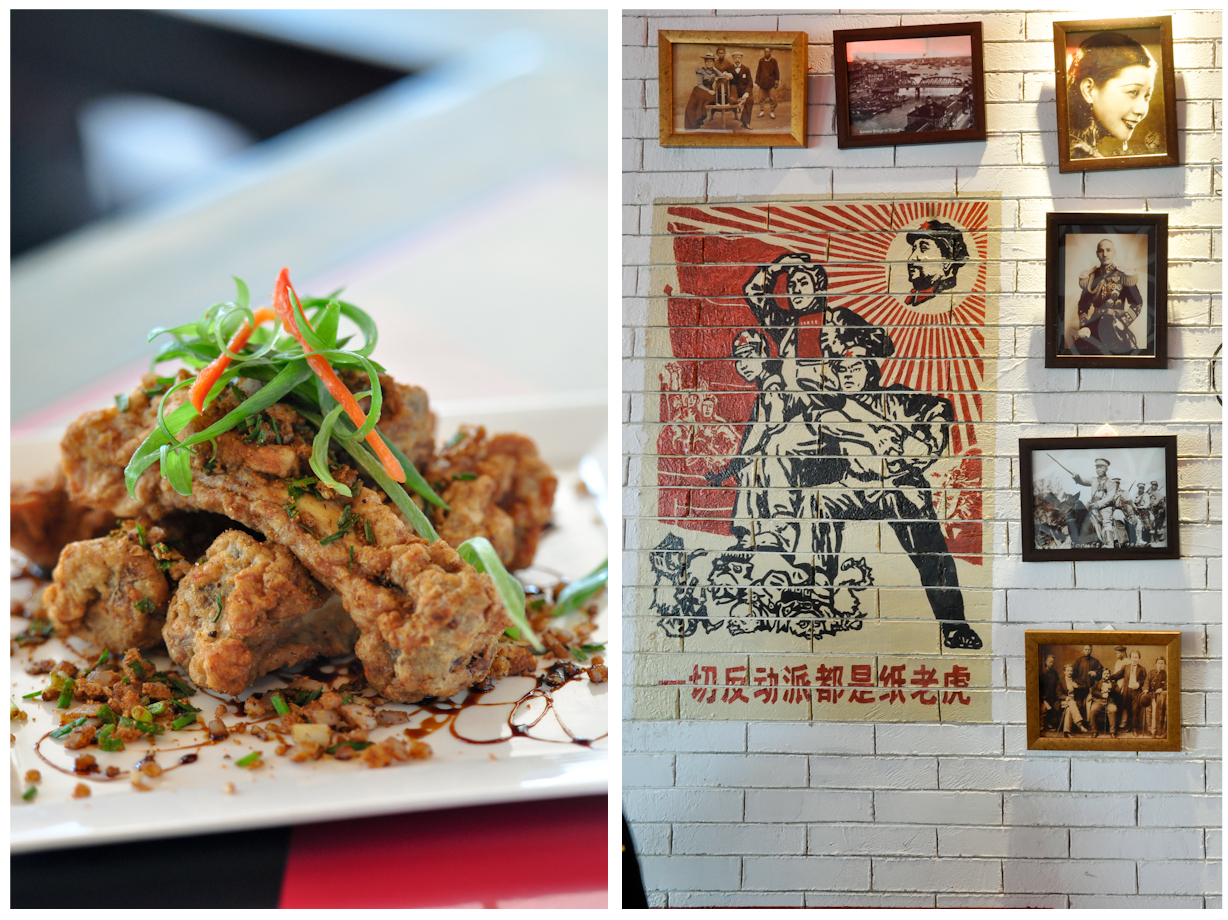
Until that day comes however, there is Komrad. Since it opened late last year, the quirky noodle and dimsum parlor in Eastwood has been attracting curious office workers and families, all of whom dine under the watchful gaze of Chairman Mao in a chef's jacket.

Seeing red: Vintage decor from China's communist heyday adorn Komrad's walls. 
Komrad is part of the Red Crab Group of restaurants whose head chef, Peter Ayson spent some time in Beijing and other Chinese cities researching on what the locals dined on. His search led him to Chef Chen Xuen who was operating out of a small eatery. Back in Manila, Ayson and Xuen have designed a menu that is authentically small-town, hearty, backwater China yet still ripe with cosmopolitan inventiveness.

Here's a different face to Chinese cuisine, at least one that's a safe remove from whatever you've tried in a Hap Chan or Kowloon. Taking the forefront are Hunan and Sichuan cooking, vibrant traditions infamous for their liberal of chilies, shallots, and garlic. (Mao Zedong hailed from Hunan Province hence the socialist concept.) Be prepared: Komrad's dishes are fierce and lusty, gratuitously oily, and often enough gleefully fried. I wouldn't have it any other way.

Xuen who is in his early thirties is himself quite the character. Shuffling back and forth between kitchen and dining area, he handed me dishes with a cheeky smile (and a twinkling silver tooth to boot) and in halting Filipino described what was at stake: Ito baboy. Ito manok. And later after dessert, Bayad kayo ha with a wink

Stalinist starters: Luscious chilled tofu with pork floss (left) and the Yakimeshi-like Komrad fried rice (right) 
The menu hearkens back to the hearty, spicy fare of China's heartland; food meant to warm you up during the cold winter months, and to open your pores come summertime. Even Chairman Mao swore by a bowl of jiggling red-tinged braised pork each day for the bright-eyed proletariat. For starters there's chilled tofu served in cascading slices swimming in soy sauce and topped with pork floss (P225). The eggplant and red bean fritters (P135) are a close second with their addictive crunch. 

For dimsum, opt for the fried Shanghai dumplings (P125) - pork balls each wrapped in a chewy, doughy mantle. There's another type laced with truffle oil, but really it's barely there. Not everything with truffle oil ends up amazing. 
Party food: Komrad's fried Shanghai pork dumplings (left), and Chef Xuen's take on Kung Pao chicken (right)
Further on, there's bite-sized Kung pao chicken almost like KFC poppers with dried chilies and peanuts (P198). These are gratifyingly crisp and mildly dry. Mind the sudden bursts of heat though, and be sure to have a glass of iced tea nearby at all times.

At one point, Xuen even brought out a small plate of pig ears in a bed of chilies, shallots, and garlic (which at this point you should be used to) that suspiciously smacked of leftovers. It's not officially on the menu, but hell, all this impromptu pulutan needed was some cold bottles of Tsing Tao to make it into perfect bar chow.


If you're adventurous look into the cumin pork ribs (P359), a rarer specimen with its telltale whiff of the exotic filling your nostrils almost immediately.

"Some customers have approached us saying their server needed deodorant, but really it's the cumin they're picking up," says Ayson with a grin. One of the staff chimed in: "Parang amoy Bumbay o Arabo!" Smell and taste are quite different however. The ribs are downright delectable with a mild, pervasive heat that coats your lips. It's not for everyone, but it is worth trying on your first visit.

Collective guilt: The sinful cumin pork ribs (left) stand out in an already quirky menu. The equally kitschy decors (right) make good use of China's revolutionary past.
So is Komrad revolutionary? Not entirely. Somewhere out there I imagine discovering the real authentic experience in a grimy little noodle and dimsum parlor in some Beijing alleyway, and not a communist-themed Eastwood restaurant. But even then, it's my gut feeling that Komrad comes close. The uncommon dishes, bold use of spices, and hearty servings will satisfy diners throughout Year of the Dragon. And if this were a lost scene from God of Cookery, I'd be rolling all over my pork ribs too.

Komrad - Mao's Hunan and Sichuan Kitchen
2nd Floor Veranda, Eastwood Mall, C5 (E. Rodriguez Avenue), Libis, Quezon City
Contact 9213440

Monday, January 2, 2012

In Lieu of the Chocolate Man

by Twinkle

He came, they saw, he faltered.


Whispers (well, text messages to be accurate) of a chocolate man roaming around the ballroom found it's way to me.  Although I arrived 30 minutes after the doors to the Grand Wine Event opened, it seems like I've missed the chocolate man!  I’m guessing people started drooling over him and scared him off.  I was left with a room full of premium wine choices, long tables lined with tapas, a giant paellera and a chocolate buffet that would make Willy Wonka proud!  A giant chocolate bar that covered the whole long table, thick brownie logs, a chocolate tree abloom with french macarons (again more chocolate!), and a dark chocolate sphere covered in giant strawberries.  

The 'forbidden fruit'?!?

I’m a chocolate macaron convert!
  I’ve got my fingers crossed hoping they have the brownies and macarons at the Marriot’s patisserie outlet.  

Going "Au Natural" at Sauceria

by Twinkle

Happy new year to all!!! After bidding adieu to a ‘food-ventful’ 2011, I’ve looked back and reflected on the yummiest bites I’ve come across during the year.  Aside from coming up with a list of 2011 favorites (watch out for that), I’ve also vowed to open up my eyes to healthier food horizons.  If you could have the yummy, with a little less of the health ouchies why not?

Jon and I found the middle ground where good food means both good for the body as well as the palate.  This healthy compromise comes in the form of the artisan restaurant Sauceria tucked away on Bonny Serrano (formerly Santolan).


When we first stepped in, it initially came across as one of those Japanese Italian restaurants that dish out big family servings and free bread.  Pastas, check.  Pizza, check.  Typical Italian fare? Definitely not.  One thing that sets Sauceria apart from the other restaurants is that they make almost everything from scratch – the breads, stocks, sauces, yogurt, and even the ketchup! 

Why go through all the trouble?  I got to talk the main man of the kitchen and he says “it’s artisan cooking. (Just like) grandma would create food like a craftsman who makes things from scratch.  The ability to create food from scratch using natural ingredients”.  Imagine a flavorful dish, sans MSG or any artificial additives.  Sauceria is all about fresh and nutritious food that tastes good naturally.  Does it actually make a difference?  You’ll have to taste it to believe it.  
 
Here are the items that top our list of favorites:

Pizza.  With so many options available in the metro, it would be hard to ‘wow’ a crowd.  Imagine my surprise when I fell in love at first bite.  Sauceria’s pizza left me wanting more, it hardly even mattered what topping you put on it.  This crust could do no wrong!  Top pizza honors go to the Salted Egg and Ampalaya, Charsiu, and the S’mores.

Salted Egg and Ampalaya Pizza (Php250)
Salted Egg and Ampalaya Pizza.  Admittedly, my first reaction was simply a non-committal ‘uhuh’.  Bitter much?  This unusual and slightly unappealing combination was actually a surprising favorite among the crowd. Pucker up and give ampalaya a chance.  You’ll never know, this veggie might just start to top your list!

Charsiu Pizza (Php 390)  and the S'mores Pizza (Php300)

Also try their salads and pastas and the appetizer to beat – the Tuna Tataki (Php340).

Sauceria's Pastas and Salads
Drinks to try would be the ginger soda, mango yogurt, and the Alamid coffee which is sourced from a Mt. Apo cooperative.

When asked to describe the food at Sauceria, we were given the simple answer -“nothing is an afterthought”.  With the extra care put into their food selection and preparation, I'd have to agree with that.

SAUCERIA

25 Bonny Serrano (formerly Santolan) Road cor Sunrise Drive, Quezon City (near Camp Crame)
Contact Number: (02) 584 3967
Email Address:  sauceria@gmail.com


Wednesday, December 21, 2011

Pork Barrel

"I can't believe they increased parking rates. It's absolutely crazy." My friend Kim was visibly, sincerely upset as we entered the parking basement of Ayala Center in Cebu. The bone she wanted to pick with the mall involved the jacking up of the parking fee - from fifteen pesos to an astonishing twenty. Flat rate. 

In Manila, that's what's considered a steal, and yet Kim would have none of it. She cussed in Bisaya, egged on by my heckling. 

Later on I floated the issue with other Cebuano friends who were just as peeved not to get their five pesos back. Until then I had just accepted the regular shilling out of hundreds of pesos weekly for parking (at one time, nearly P300 in Makati) in Manila as the norm, but then I realized that the locals and I operated on different wavelengths. The differences however, did not end here.

I've always felt that Manila and Cebu have always been at odds, locked in some kind of quasi-cultural rivalry that I haven't fully understood yet. But if there's one thing where Cebu constantly out-trumps Manila, it's with lechon. This was obviously made plain when two friends escorted me to the nearest Zubuchon outlet.

Pigging out: Diners flock to Zubuchon made famous by Anthony Bourdain's endorsement
Zubuchon is the creation of Joel Binamira, more commonly known by his nom de guerre Market Man of marketmanila.com. The restaurant's popularity stems from its flagship lechon cooked sans MSG or gears or additives. Instead he does things 'ye olde fashion way' with lemongrass, pepper, olive oil, and sea salt as healthier alternatives. (It's also with some consolation that the pigs themselves are raised in private backyards, and cheerfully trot around. But not for long.) 

The lechon is staked on bamboo poles, stuffed with herbs and spices, and roasted diligently over a charcoal pit by a crack team of lechoneros. The result is lusty, succulent, flavorful pork tucked under crisp, liempo-like crispy skin. In short -- a cardiologist's worst nightmare.

Let's get it on, Lechon: Zubuchon's flagship is packed with flavor inside and out
"It's all-natural lechon. I heard the pigs are raised on a diet of chicos," mulled my friend Clark who drove us to Zubuchon's newest branch along Escario Street. It was a busy Sunday night for the staff who promptly announced to us that they had, as of seven thirty in the evening, run out of lechon. And with good reason: Joel's lechon first became a hit at one of Cebu's weekend markets, and by the time word got out, No Reservation's Anthony Bourdain had also chirped in with his own  testimonial that it was the "World's best whole roasted pig" - a claim scribbled on each of the branch's glass counters.

  
Left: The staff works around the clock to keep up with the holiday rush. Right: Among Zubuchon's other pork offerings are slow-cooked adobo, dinuguan, chorizo, pork flakes, and yes, even Zubuchon-certified pork lard.
Not content with lechon, Zubuchon also offers other pork staples borrowed from the carnivorous Filipino mindset like dinuguan, chorizo, and even sisig. It's enough to make one's knees quiver. After the letdown at the restaurant, Clark and I headed to another branch that was busy plying in pigs. The restaurant was packed. The staff squeezed through the aisles made narrow by long tables of families while other customers were huddled over the counter for take-out. And everywhere - the constant tearing and tugging and nibbling of lechon skin.  

Visitors to Cebu (whose ancient name was 'Sugbu' hence 'Zubuchon'), need not return empty-handed to their friends back home. There's much to be had in terms of frozen lechon or chicharon. I took home some from the tiny take-out stand at the pasalubong section of Mactan Airport's departure gate. Clutching my two bags-worth of pasalubong, I was ready to barrel down the security check point. All it took however was a flash of the logo on one of the take-out bags, and the airport personnel already seemed to understand the graveness of my intentions. I'd either come home with lechon or not leave at all. 

The next morning, I had lechon for breakfast. That night, more of it. When that run its course, it was time for paksiw.   

The morning-after takeout lechon. Still pretty good. 
Zubuchon
Escario Building, Escario Street, Cebu City (032) 5835699
One Mango Avenue Building, Cebu City (032)2395697
Mactan Airport Departure Lounge, Mactan City (63) 0917 6274761