Pipino's irresistible watermelon with asparagus, taro miso mash, and pickled mushrooms
will have you smitten for summer and beyond
As a rule, I don't grill my fruits.It's just one of those things - like walking with wet socks or eating a whole jar of mayonnaise with a spoon. I'd rather not, thank you very much. Fruits by all accounts are meant to be served chilled, preferably in bite-sized juicy chunks, or, in the case of watermelon, sliced into big wedges you dive your whole face in. That's what makes watermelon, well, a watermelon.
Last week however, vegan snack shack Pipino in sleepy Teachers Village came out with a 5-course Valentine's meal that included, among other things, watermelon steak. This was unheard of in my dining vocabulary, though New York Times food columnist Mark Bittman would have you think otherwise.
Says Bittman:
"Watermelon is not a vegetable, obviously, but it’s so wonderful when grilled [...] Grill a watermelon slice, and it dries out and sobers up, losing its sloppy sweetness, and it takes surprisingly well to savory accompaniments. Add a slice of good melting cheese, a hard roll, a few pickles and a lettuce leaf, and look out: watermelon burgers."
Pipino's new watermelon steak is just that: A thick, red wedge that's actually pretty to look at. On biting, it does't give too quickly, and releases nearly that same smoky flavor you'd associate with your favorite T-bone. Here it's served with asparagus and pickled mushrooms that adds welcome zing. A clump of taro miso mash satisfied my need for carbs.
Will it fly with diners? For vegans it's a no-brainer. But as a regular guy who can appreciate a fine slab of rib-eye, it's definitely still worth trying. Just don't expect to be filled up in a way only honest to goodness, proteiny meat can. Have it if you're coming to grips with your Lenten fast or curious to sample creative vegan cooking. It's definitely a notch higher than masquerading gluten and tofu as animal parts, and you get to love fruit in a whole different way. Now if someone could start cooking watermelon burgers...
Pipino
39 Malingap Street, teachers Village, Quezon City
Contact (63) 2 4411773
Visit www.pipinovegetarian.com
Gong Xi Fa Cai! What I know of Chinese New Year I've learned from ampao red envelopes containing McDonald's coupons. That and a Mandarin hat my dad once bought complete with a fake braided pigtail. This my ten-year old self wore one United Nations Day in grade school as he shuffled around the classroom and repeatedly bowed to every classmate. Karma would catch up ten years later in America when guards at my school dorm consistently mistook me for a Chinese food delivery boy. That however is for another time.
My knowledge of Chinese cuisine is only slightly better. Weaned on episodes of Cooking Master Boy and Stephen Chow's God of Cookery, I treat good Chinese food - whether it's Wok Inn's pork 'sipa' fried wontons or fresh noodles in Binondo's Ling Nam - with fanatical reverence. After all, the only proper way to appreciate a chef's cooking is by rolling all over your food before fainting.
The same goes for Cooking Master Boy's delicious-sounding 'China Within A Fish Stomach', which would be the most insane fish relleno ever made.
Until that day comes however, there is Komrad. Since it opened late last year, the quirky noodle and dimsum parlor in Eastwood has been attracting curious office workers and families, all of whom dine under the watchful gaze of Chairman Mao in a chef's jacket.
Seeing red: Vintage decor from China's communist heyday adorn Komrad's walls.
Komrad is part of the Red Crab Group of restaurants whose head chef, Peter Ayson spent some time in Beijing and other Chinese cities researching on what the locals dined on. His search led him to Chef Chen Xuen who was operating out of a small eatery. Back in Manila, Ayson and Xuen have designed a menu that is authentically small-town, hearty, backwater China yet still ripe with cosmopolitan inventiveness.
Here's a different face to Chinese cuisine, at least one that's a safe remove from whatever you've tried in a Hap Chan or Kowloon. Taking the forefront are Hunan and Sichuan cooking, vibrant traditions infamous for their liberal of chilies, shallots, and garlic. (Mao Zedong hailed from Hunan Province hence the socialist concept.) Be prepared: Komrad's dishes are fierce and lusty, gratuitously oily, and often enough gleefully fried. I wouldn't have it any other way.
Xuen who is in his early thirties is himself quite the character. Shuffling back and forth between kitchen and dining area, he handed me dishes with a cheeky smile (and a twinkling silver tooth to boot) and in halting Filipino described what was at stake: Ito baboy. Ito manok. Andlater after dessert, Bayad kayo ha with a wink.
Stalinist starters: Luscious chilled tofu with pork floss (left) and the Yakimeshi-like Komrad fried rice (right)
The menu hearkens back to the hearty, spicy fare of China's heartland; food meant to warm you up during the cold winter months, and to open your pores come summertime. Even Chairman Mao swore by a bowl of jiggling red-tinged braised pork each day for the bright-eyed proletariat. For starters there's chilled tofu served in cascading slices swimming in soy sauce and topped with pork floss (P225). The eggplant and red bean fritters (P135) are a close second with their addictive crunch.
For dimsum, opt for the fried Shanghai dumplings (P125) - pork balls each wrapped in a chewy, doughy mantle. There's another type laced with truffle oil, but really it's barely there. Not everything with truffle oil ends up amazing.
Party food: Komrad's fried Shanghai pork dumplings (left), and Chef Xuen's take on Kung Pao chicken (right)
Further on, there's bite-sized Kung pao chicken almost like KFC poppers with dried chilies and peanuts (P198). These are gratifyingly crisp and mildly dry. Mind the sudden bursts of heat though, and be sure to have a glass of iced tea nearby at all times.
At one point, Xuen even brought out a small plate of pig ears in a bed of chilies, shallots, and garlic (which at this point you should be used to) that suspiciously smacked of leftovers. It's not officially on the menu, but hell, all this impromptu pulutan needed was some cold bottles of Tsing Tao to make it into perfect bar chow.
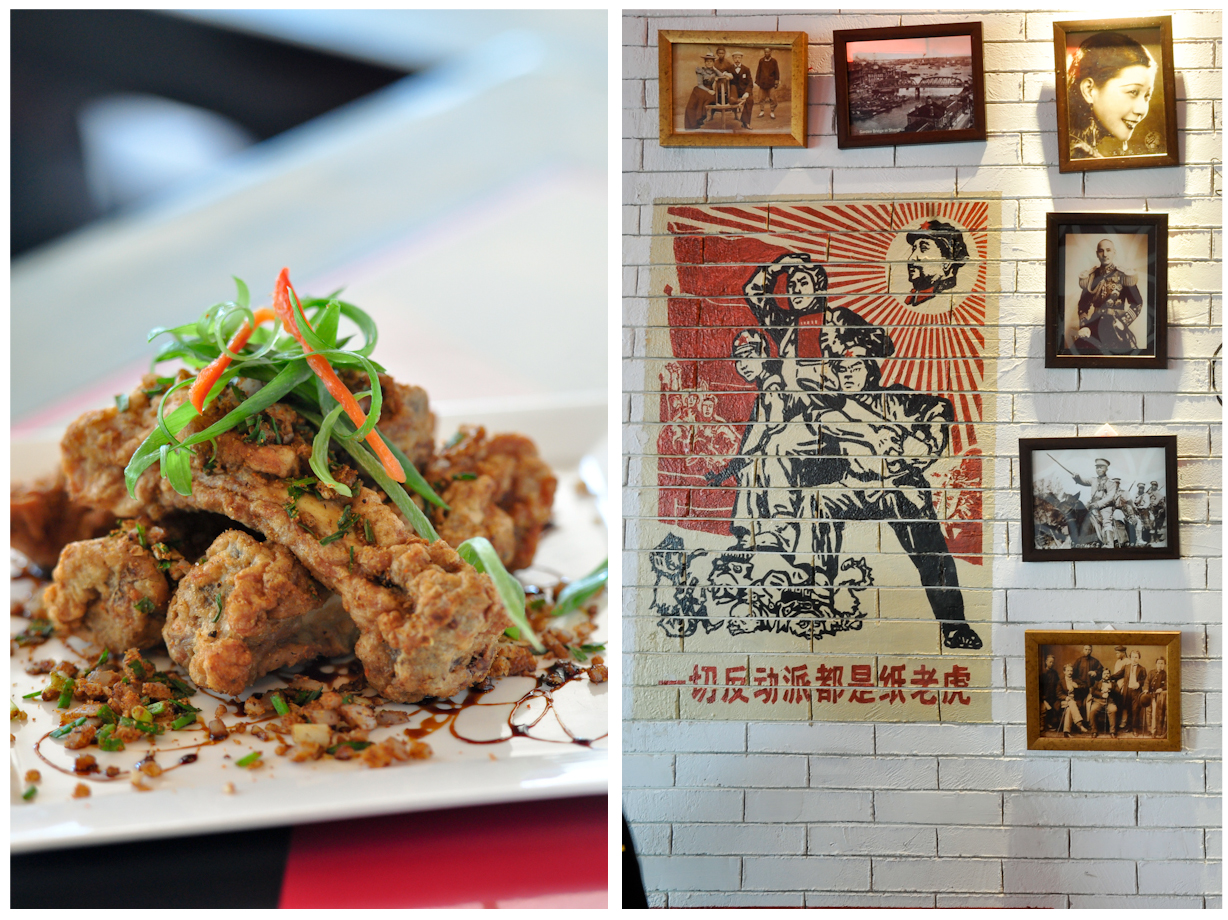
If you're adventurous look into the cumin pork ribs (P359), a rarer specimen with its telltale whiff of the exotic filling your nostrils almost immediately.
"Some customers have approached us saying their server needed deodorant, but really it's the cumin they're picking up," says Ayson with a grin. One of the staff chimed in: "Parang amoy Bumbay o Arabo!" Smell and taste are quite different however. The ribs are downright delectable with a mild, pervasive heat that coats your lips. It's not for everyone, but it is worth trying on your first visit.
Collective guilt: The sinful cumin pork ribs (left) stand out in an already quirky menu. The equally kitschy decors (right) make good use of China's revolutionary past.
So is Komrad revolutionary? Not entirely. Somewhere out there I imagine discovering the real authentic experience in a grimy little noodle and dimsum parlor in some Beijing alleyway, and not a communist-themed Eastwood restaurant. But even then, it's my gut feeling that Komrad comes close. The uncommon dishes, bold use of spices, and hearty servings will satisfy diners throughout Year of the Dragon. And if this were a lost scene from God of Cookery, I'd be rolling all over my pork ribs too.
Komrad - Mao's Hunan and Sichuan Kitchen 2nd Floor Veranda, Eastwood Mall, C5 (E. Rodriguez Avenue), Libis, Quezon City Contact 9213440
While doing an errand in Sikatuna Village, a friend took me to Chef Tatung's, both the home and restaurant of Myke 'Tatung' Sarthou. It was a spur of the moment side trip, and we didn't get to try a meal (this time), but Tatung gave us a tour of the redone place. He also served some refreshing tuba-turned-sherbet perfect to fend off the afternoon heat. The blue flower was picked from his own garden.
Tatung's menu has gone through some changes: first European then Pan-Asian and finally, as if realizing he had to return to his own roots, he's back to the basics of Filipino although with his own personal touches.